

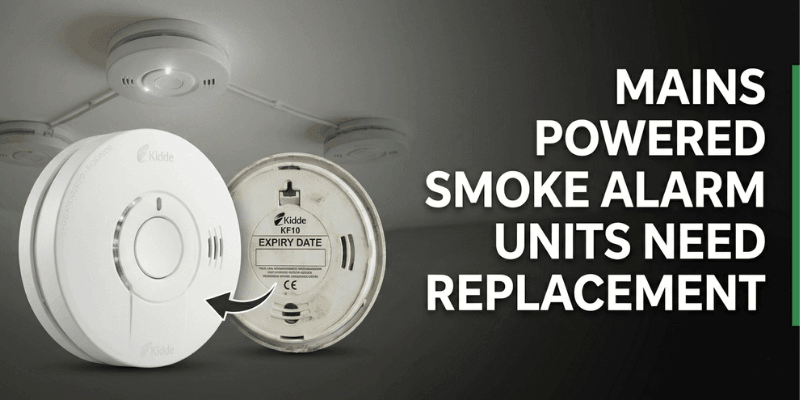
If the mains-powered smoke alarm units in your home are wired directly into your household electricity supply, you probably feel pretty safe. It is one of the most common things we assume as homeowners, because an alarm is hard-wired into the mains power, it will just keep working forever, but that’s not the case. Your mains smoke alarm unit replacement should happen every 10 years.
The truth is, even the most expensive, high-tech smoke alarm units have a strict expiry date. To keep your family and your home safe, you absolutely must replace them.
Whether your home was built during the post-1992 housing boom, when mains-powered units became a legal standard, you have lived in your new-build home for over a decade, or you cannot remember the last time your alarms were replaced, your life-saving sensors might be completely worn out, or you are managing a modern rental property, understanding this decade-long lifespan is crucial.
In this guide, I will take you through everything you need to know about these life-saving devices, look at why these units fail, how to read their warning signs, and how popular units like the Kidde Firex KF10 hard-wired mains smoke alarms can be easily replaced after 10 years or upgraded to the newer Kidde Firex KF20 model without any stress.
Why The Need For Replacement Every 10 Years?
We all wonder why the mains smoke alarm replacement if it is still getting constant electrical power. The issue is not the electricity; it is the delicate sensor chamber inside the unit.
Every single day, your smoke alarms are quietly working to protect you. Over ten years, millions of tiny airborne particles pass through them. This includes normal household dust, cooking fumes, steam from the bathroom, aerosol sprays, and even tiny bugs.
Slowly but surely, this dirt builds up inside the internal sensor chamber. This build-up causes the internal sensor to degrade, which leads to two major problems:
-
It becomes less sensitive: The sensor gets choked up with dust and can no longer spot real smoke from a house fire, which robs you of vital escape time.
-
It causes false alarms: The unit starts to get confused by normal air currents and triggers annoying false alarms, often in the middle of the night.
The Button Test Myth: Pressing the test button on your mains-powered smoke alarm and hearing a loud beep does not mean the sensor is working. The button only checks the electrical circuit and the horn, and it cannot tell you if the internal sensor is too dirty to detect actual smoke.
Fire Safety Standards and Legal Requirements for Mains Smoke Alarms
If you own or manage a property in the UK, failing to refresh old smoke alarms carries varying degrees of legal and financial risk. Fire safety regulations are strictly enforced, especially across rental and newly constructed sectors.
For landlords, compliance is not optional. The Smoke and Carbon Monoxide Alarm (England) Regulations 2022 require at least one operational smoke alarm on every storey of a rental property.
The 1992 Building Regulations Milestone for Smoke Alarms
Building regulations in England and Wales changed significantly in 1992, mandating that all newly built residential properties must have interconnected, mains-powered smoke alarms fitted as standard. If your home was constructed between 1992 and 2016 and you have never changed the detector heads, your life-saving equipment is now severely outdated and operating well outside its safe parameters.
In Scotland, fire safety laws are even tighter. Following legislation enacted in February 2022, all Scottish homes must feature an interlinked system of smoke and heat alarms. This includes a smoke alarm in the living room, alarms in circulation spaces like landings and hallways, and a dedicated heat alarm in the kitchen.
The Secret Language of Beeps: Unit Replacement vs Battery Issues
When your ceiling starts talking to you in short, sharp chirps, it is easy to get frustrated. However, your smoke alarm uses different sounds to tell you exactly what is wrong. Understanding these noises will help you figure out if you just need a new backup battery type or if the entire unit has reached its end of life, and the mains smoke alarm replacement is due.
The Low Battery Chirp
If your mains smoke alarm is otherwise healthy but its backup battery is running low, it will usually make a single, short beep once every 40 to 60 seconds. This means the 9V backup battery needs to be swapped out so the unit can still protect you during a power cut.
The End of Life Warning
When the full 10 years are up and the internal sensor degrades completely, modern smoke alarms will sound a different alert pattern. For example, many units will give a double beep or a specific fault chirp alongside a flashing light to signal your mains smoke alarm replacement after 10 years.
Popular Mains Smoke Alarm Unit Brands and Models
The most popular and widely trusted mains-powered smoke alarm brands in the UK include Aico, Kidde (Firex), and FireAngel. These brands are heavily stocked by local electrical wholesalers and major hardware retailers, and are fully compliant with UK building regulations.
Kidde Firex KF10 Mains Smoke Alarm As The Popular Choice
If your home was built or renovated over the last fifteen years, look up—you might just spot a Kidde KF10 staring back at you. This little white disc has been an absolute staple on ceilings up and down the UK. It is a mains-powered unit that plugs straight into your home’s 230V electricity supply, using a standard 9V alkaline battery as a backup to keep you safe if the power ever trips.
Because they are incredibly reliable and can be linked together through your house wiring—meaning if the downstairs alarm spots trouble, every alarm in the house sounds off—builders absolutely loved installing them.
Let’s take a quick look at how the classic KF10 shapes up:
-
The Technology Inside: It uses an ionisation sensor. Back in the day, this was the standard for spotting fast-flaming fires, though modern safety guidelines now heavily favour a different approach.
-
Power Setup: It runs on your 240V mains electricity, with a standard replaceable 9V battery tucked inside to handle power cuts.
-
The Link Network: You can wire it together with up to 23 other compatible Kidde or Firex alarms for whole-house protection.
-
Current Status: The KF10 has officially been retired and discontinued by the manufacturer.
Meet the Ultimate Mains Smoke Alarm Unit Upgrade: The Kidde Firex KF20
Because the older KF10 model is no longer being made, Kidde has introduced its direct modern successor: the Kidde KF20 (you can also grab the KF20R version, which comes with a sealed, rechargeable lithium backup battery so you never have to change a 9V cell again).
Moving up to the KF20 brings two massive upgrades to your home safety setup:
1. Smarter Sensors, Fewer False Alarms
The big shift here is the move to optical technology. While the old model relied on ionisation, the KF20 uses a clever photoelectric beam of light. This makes it lightning-fast at detecting slow, smoky, smouldering household fires—like those started by overloaded extension leads or a stray cigarette on a sofa cushion. Even better? It is incredibly smart at ignoring kitchen steam and burnt toast, saving you from those frantic midnight false alarms.
2. A True Two-Minute DIY Swap
I know the idea of replacing a mains-powered electrical item sounds intimidating, but Kidde has done something brilliant here. The brand-new KF20 is designed to fit onto the same ceiling base plate and use the same three-pin wire plug as your old KF10.
You do not need to rewire anything, adjust the mounting base, or call out your local electrician. Once you safely isolate the power at your fuse box, you simply slide the old KF10 off, swap the plug over to the new optical unit, and click the KF20 straight into place. It is a perfect, stress-free upgrade that gives you an instant, fresh 10-year safety window.
The Difference Between the Kidde Firex KF10 and KF20 Mains Smoke Alarm Units
If you look up at your ceilings right now, there is a very high chance you will see a Kidde Firex alarm. They are among the most popular hard-wired alarms fitted in UK homes over the last fifteen years.
If you currently have the older Kidde Firex KF10, you need to know about its modern replacement. The old KF10 model used an ionisation sensor, which was great at detecting fast-flaming fires but was highly prone to false alarms from burnt toast.
The newer Kidde KF20 is the replacement, and it has an optical detector. Optical sensors use a small light beam inside the chamber. They are much better at detecting slow, smouldering fires, such as those caused by electrical faults or sofa cushions, and they are far less likely to go off accidentally when you are cooking.
Because of this improved safety profile, optical alarms like the KF20 are now the preferred standard for circulation spaces like hallways and landings.
How to Check for the Mains Smoke Alarm Replacement Date
Checking the exact age of your mains smoke alarm unit is a simple task that you can do this weekend. You do not need any special tools, just a sturdy set of steps or a ladder to reach the ceiling safely.
Finding Your Smoke Alarm Replacement Date Label
To find the age of your smoke alarm, you need to remove the main body from the ceiling. For most models, you simply give the unit a firm twist anti-clockwise or slide it off its base. Once it is in your hands, turn it over and look at the large sticker on the back.
You will see a printed manufacture date or a specific “Replace By” date. If your smoke alarm unit only lists the date it was made at the factory, just add 10 years to that number. If that date was more than a decade ago, it is time to order a new one.
Can You Replace a Mains Smoke Alarm Yourself?
The short answer is yes, you absolutely can undertake a mains smoke alarm replacement yourself, provided you are staying within the same brand family. This is because a full unit change is completely different from a standard 9V backup battery replacement, but manufacturers have made the process incredibly user-friendly.
The best news for anyone with Kidde units is that the base unit for the KF10 and KF20 is identical, so only the alarm unit needs replacing.
The base plate is the plastic part that is screwed into your ceiling and wired directly into your home’s electrical cables. Because Kidde kept the design identical, you do not have to touch any live house wiring or change the ceiling base. You simply unclip the old, expired KF10 alarm unit and slide the new optical KF20 straight onto the existing base plate. It is a true plug-and-play upgrade that takes less than two minutes per room.
Step-by-Step Guide to Swapping Your Mains Smoke Alarm Unit Safely
If you are ready to upgrade your old mains-powered smoke alarm to the new KF20 models, follow these simple steps to complete the job safely and confidently.
-
Turn off the power: Go to your main electricity fuse box. Find the switch marked for your smoke alarms or downstairs lighting and flip it to the “Off” position. Check the little light on the front of your alarm to make sure it has gone out.
-
Remove the old unit: Give the old alarm head a gentle twist or slide it firmly across the base plate to unclip it.
-
Unplug the wire clip: You will see a small plastic plug with three wires connecting the ceiling base to the back of the mains smoke alarm. Pinch the sides of this plastic plug and pull it out from the old alarm body.
-
Pop in the new backup battery: Open the battery drawer on your brand-new KF20 unit and connect a fresh 9-volt backup battery type, ensuring the positive and negative terminals match up perfectly.
-
Plug in and mount the new alarm: Take the plastic plug coming from the ceiling and push it firmly into the back of your new KF20 alarm until it clicks. Slide the new alarm onto the old base plate until it locks tight.
-
Restore power and test: Turn your electricity supply back on at the fuse box. The green light on your new alarm should shine steadily. Press the central test button for a few seconds until the alarm lets out a loud, clear blast to confirm everything is working beautifully.
Conclusion
Mains smoke alarm replacement is important because your home’s smoke alarms are the most important piece of safety technology you own, working silently every second of the day to protect the people you love most.
Don’t leave your family’s safety to guesswork or assume that hard-wired power means permanent protection. Take a few moments today to check the dates on your ceiling units.
If you find an old model like the Kidde Firex KF10 up there, grab a replacement Kidde KF20 unit and enjoy the absolute peace of mind that comes with a fresh, reliable decade of home fire safety.
Questions People Ask
Can I use a regular 9V alkaline battery for the backup, or do I need a special type?
Standard, high-quality 9V alkaline batteries are perfect for the backup compartment in Firex units. Kidde recommends Energiser 522, Duracel MN 1604, Duracel MX 1604, FDK CP-V9Ju or Ultralife U9VL-J-P 9V battery as printed on the label at the back of the unit. Just remember that changing this battery every year is a temporary power backup fix; it does not reset the 10-year lifespan of the main sensor chamber.
My wired mains alarm keeps beeping even after I put a brand new backup battery in. What is causing this?
If it keeps chirping after a battery change, it usually means the internal sensor is either heavily clogged with dust or the unit has passed its 10-year lifespan and has triggered its automatic internal expiry fault. In both cases, replacing the entire alarm head is the best solution.
Do I need to replace all the interconnected alarms in my house at the same time?
It is highly recommended. Hard-wired alarms are usually linked together by a signal wire so that if one detects smoke, they all sound off together. If one alarm has reached its 10-year expiry mark, the others installed at the same time will be just as old and worn out. Swapping them all at once ensures your full network remains reliable.
Where can I look up official advice on UK fire alarm regulations for my home?
For official, authoritative fire safety guidelines and legal property requirements, you can check the UK Government Fire Safety Regulations
or read through the latest home safety toolkits provided by the National Fire Chiefs Council.
Where can I buy the Kidde Firex KF20 Wired main Fire Smoke Alarm?
A quick online search will yield a good result, but you can also buy the Kidde Firex KF20 from eBay
