

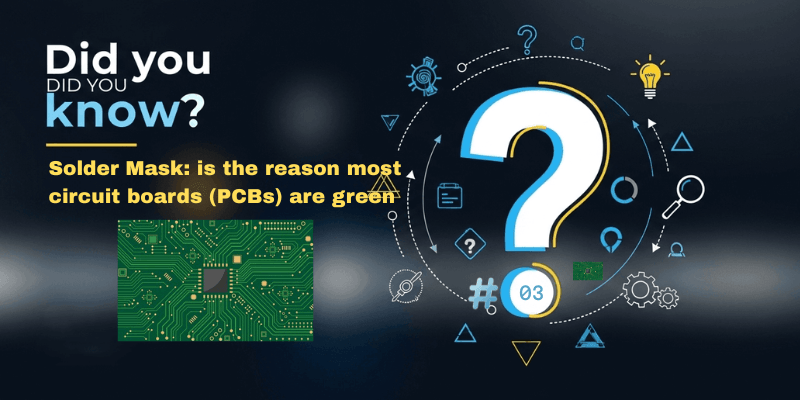
If you’ve ever peeked inside a broken remote or a computer, you’ve seen it: that classic, grassy-green board covered in tiny silver lines. But in a world where we can make plastic any colour, why is green still the gold standard for electronics?
It’s Not Just a Style Choice
That green layer is actually something called Solder Mask. Its job is to protect the copper circuits from moisture, dust, and accidental short-circuits. Most Printed Circuit Boards (PCBs) feature a signature green hue thanks to the solder mask, a specialised protective coating.
Originally, manufacturers favoured green epoxy resins because they were exceptionally durable and cost-effective. Beyond budget, this specific shade provides the highest visual contrast for inspecting solder joints. This clarity reduces eye strain for technicians and allows for the high-precision soldering required in modern, compact electronics.
The “Bargain” Beginning
Back in the mid-20th century, when engineers were first developing Printed Circuit Boards (PCBs), they needed a reliable “resin” to coat the boards.
The Winner and Reason
A base of green epoxy resin. It was the most effective chemical formula at the time, and crucially, it was the cheapest to mass-produce.
The Human Factor (The “Eye” Test)
As the industry grew, green stayed on top for a surprising reason: Human Biology. Engineers used to have to inspect these boards by hand using magnifying glasses. Studies found that the human eye is most sensitive to green light.
This makes it much easier for inspectors to spot tiny errors, scratches, or broken traces against a green background compared to red or blue.
Forward To Today & Tech Advancement
Today, you can get circuit boards in black, blue, white, or even “pro” matte purple (popular with hobbyists!). However, because green is produced in such high volumes, it remains the fastest and cheapest option for manufacturers worldwide.
TechRater UK: Did You Know #03
Questions People Ask
Not really, though dark colours like black can hold more heat, and white can be harder to solder because it reflects too much light!
Modern solder masks are much safer than the old versions, but you should still always recycle your electronics properly at a specialised centre.
Absolutely! While green is the “standard,” you can now find PCBs in blue, red, black, white, and even purple or orange. High-end gaming components often use black or white for a sleeker look, though these colours are usually more expensive to produce and harder to inspect for tiny flaws.
Not quite. The core of the board is usually a yellowish-brown material called FR-4 (a reinforced glass epoxy). The green you see is just a thin, protective “skin” called the solder mask, which is rolled or sprayed over the top to protect the copper circuits.
Those are likely older, cheaper boards made from synthetic resin-bonded paper. They didn’t always use a solder mask (the green coating) because the circuits weren’t as small or complex as they are today. If you see a brown board, you’re looking at a piece of tech history!
A small scratch on the green mask usually won’t hurt anything. However, if the scratch is deep enough to cut the copper “traces” (the silver or gold lines) underneath, the device will stop working because the electricity can’t flow through the “broken bridge.”
