

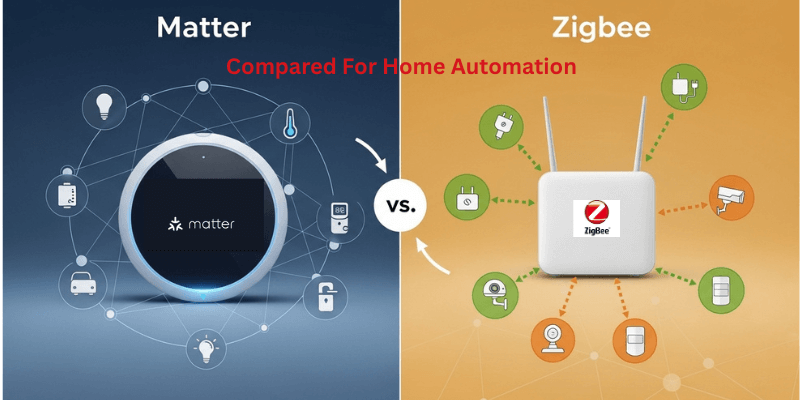
Building a smart home can feel like navigating a maze of technical acronyms. If you are looking to automate your lighting, heating, or security, you have likely encountered the two heavyweights of the industry: Matter and Zigbee. While Zigbee has been the reliable backbone of smart homes for over two decades, Matter is the ambitious new standard promising to unify every device under one roof.
Understanding the difference between these two is crucial. Choosing the wrong path could leave you with a collection of gadgets that refuse to talk to each other or a hub that becomes obsolete within a year. In this comprehensive guide, we compare Smart Home Hubs, dive into the technical nuances of Matter and Zigbee, and help you decide which protocol deserves a place in your home automation setup.
What is a Smart Home Hub? Understanding the Central System
A smart home hub acts as the central nervous system for your connected devices. It translates various “languages” (protocols) so that your Philips Hue bulbs, Yale smart locks, and Nest thermostats can work together in a single automation.
While many modern devices connect directly to your Wi-Fi, having too many Wi-Fi gadgets can clog your bandwidth and slow down your internet. This is where dedicated protocols like Zigbee and Matter-over-Thread come in. They create a “mesh network” that operates independently of your main Wi-Fi, ensuring your smart home remains snappy and responsive.
The Zigbee Standard: Proven Reliability and Low Power
Zigbee has earned its reputation as the “gold standard” for low-power mesh networking. Because it has been around since the early 2000s, and has a vast ecosystem.
Why Zigbee Still Wins Today
-
Battery Efficiency: Zigbee devices are incredibly “light” on power. A simple door sensor or button can last 2 to 3 years on a single coin-cell battery.
-
Mature Ecosystem: From IKEA Tradfri to Amazon Echo (with built-in Zigbee), the hardware is affordable and widely available in the UK.
-
Self-Healing Mesh: If one Zigbee bulb in your hallway fails, the signal simply reroutes through another device to reach its destination.
However, the main drawback of Zigbee is its “walled garden” nature. A Zigbee device usually needs a specific hub from the same manufacturer or a highly compatible one to work properly.
Matter: The Unified Future of Home Automation
Matter is not just another protocol; it is a “universal translator” designed by the Connectivity Standards Alliance (CSA), which includes Apple, Google, and Amazon. Its goal is simple: if a box has the Matter logo, it will work with Apple Home, Alexa, and Google Home simultaneously.
Matter vs Zigbee: The Connectivity Shift
Unlike Zigbee, Matter is an “IP-based” protocol. This means it runs on top of existing network technologies like Wi-Fi, Ethernet, and a newer mesh technology called Thread.
-
Matter-over-Wi-Fi: Used for high-bandwidth devices like smart cameras and TVs.
-
Matter-over-Thread: Used for low-power devices like sensors and light switches, directly competing with Zigbee’s efficiency.
The release of Matter 1.4 and Matter 1.5 in late 2025 and early 2026 has significantly improved the stability of “Multi-Admin” features. This allows a single smart lock to be controlled by a family member using an iPhone and another using an Android device without any complex workarounds.
Direct Comparison: Matter vs. Zigbee
To help you decide, we have broken down the key differences between these two technologies as they stand today.
| Feature | Zigbee | Matter (over Thread/Wi-Fi) |
| Interoperability | Moderate (often requires specific hubs) | High (Universal compatibility) |
| Setup Process | Hub-dependent pairing | Simple QR code scanning |
| Network Type | Non-IP Mesh | IP-based Mesh (Thread) or Wi-Fi |
| Battery Life | Excellent (up to 3 years) | Very Good (improving with Matter 1.4) |
| Range | 10–20m per node (Mesh) | 10–30m per node (Mesh) |
| Data Speed | Low (250 kbps) | High (Wi-Fi) / Low (Thread) |
Interoperability and the “Multi-Admin” Edge
The most significant advantage of Matter is the Multi-Admin feature. In a traditional Zigbee setup, if you pair a bulb to a Philips Hue Bridge, it is “owned” by that bridge.
To see it in another app, you need a software-level integration. With Matter, the device can be shared across multiple controllers natively. You could have a Google Nest Hub in the kitchen and an Apple HomePod in the bedroom, both controlling the same Matter-certified light strip without latency.
Conclusion
If you are starting fresh, your best bet is a “Multiprotocol” hub that supports both Zigbee and Matter. This gives you the freedom to buy cheaper Zigbee sensors while future-proofing with Matter-over-Thread bulbs.
The battle between Matter and Zigbee, and which one to choose, isn’t about one replacing the other. Instead, it is about how they coexist.
Choose Zigbee if you want a mature, stable, and affordable ecosystem today. It is perfect for those who don’t mind staying within one or two brands (like IKEA or Hue) and want the best possible battery life for sensors.
Choose Matter if you want maximum future-proofing and the freedom to mix and match any brand of hardware. If you are an “all-Apple” or “all-Google” household, Matter is the path to a seamless experience.
Questions People Ask
No. Most major manufacturers have released “Matter Bridges.” For example, if you have a Philips Hue Bridge, a software update has likely already made your old Zigbee bulbs “visible” to Matter controllers.
No. Matter is the “language” (the application layer), while Thread is the “road” it travels on (the networking layer). You can have Matter devices that run over Wi-Fi instead of Thread.
Yes, but they won’t talk to each other directly. You need a hub that supports both and acts as a translator between the two networks.
One of Matter’s core pillars is local control. While you need the internet for initial setup or remote access, your automations (like a motion sensor turning on a light) will continue to work even if your broadband goes down.
